What was the FIRST Artificial Intelligence?
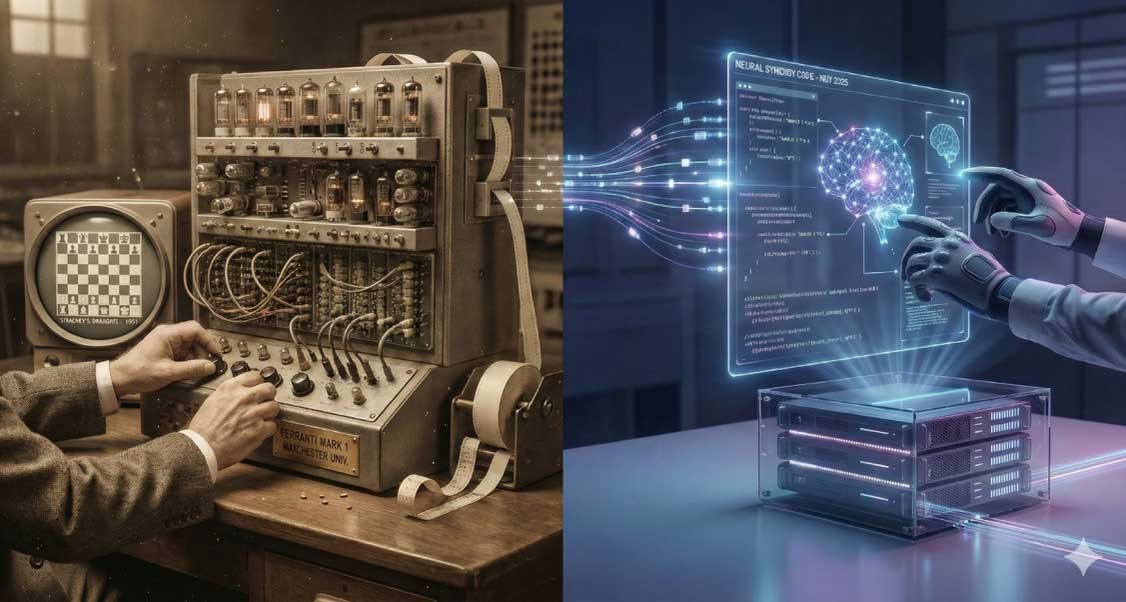
Table of Contents
- # From Giant Machines to Superbrains: The History of AI
- # The Origin: When Machines Began to Play and Think (1951–1956)
- # The Four Titans: The Superbrains of 2025
- # Conclusion: What Does “Thinking” Mean Now?
- # Listen to our podcast created with NotebookLM.
- # Watch the full video explanation (also made with NotebookLM).
From Giant Machines to Superbrains: The History of AI
Welcome to November 2025! Today, Artificial Intelligence (AI) is like electricity—it's everywhere, and we use it for everything. But did you know that decades ago, computers were the size of a room and less powerful than your calculator?
To understand how we got to today’s digital superbrains, we need to travel back to the past, when scientists dreamed of creating machines that could think like we do.
The Origin: When Machines Began to Play and Think (1951–1956)
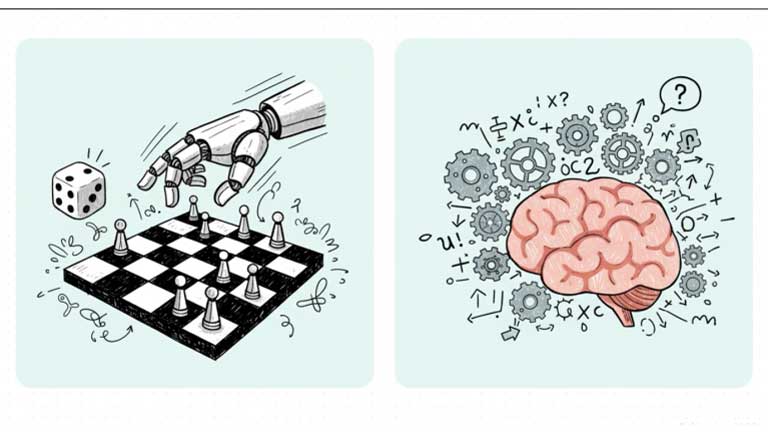
Imagine a world without the internet or mobile phones. In the 1950s, computers were huge and extremely hard to use. In that world, the two “grandfathers” of AI were born: one that learned to play, and another that learned to solve math problems.
The Practical Player: The Checkers Program (1951)
In England, a teacher named Christopher Strachey wanted to see if a machine could win a board game.
The Challenge: Computers had almost no memory (less than a short text message!).
The Breakthrough: Strachey created a program to play Checkers. Since the machine couldn’t calculate every possible move, he taught it “tricks” (heuristics) to guess the best one. It was the first time a machine did something both intelligent and fun!
The Logical Thinker: The Logic Theorist (1956)
Meanwhile, in the United States, three scientists—Newell, Simon, and Shaw—wanted something different: a machine that could reason like a scientist.
The Invention: They created the Logic Theorist.
The Achievement: They gave it an extremely difficult math book (Principia Mathematica) and asked it to prove the formulas. The machine solved 38 out of 52 problems—and even found a solution that was shorter and more elegant than the human version. It was the first proof that a machine could use logic.
The Four Titans: The Superbrains of 2025
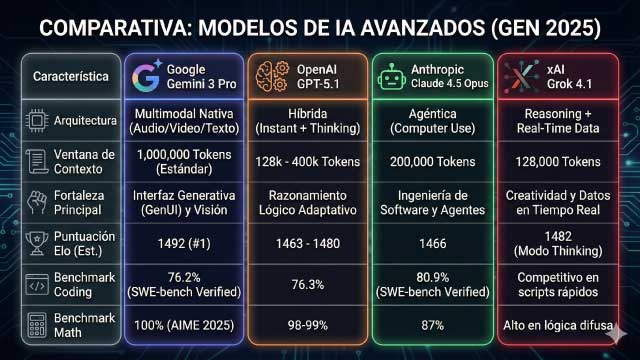
Jump to the present. In November 2025, we no longer have simple checkers programs. Now we have four incredibly powerful AI “Titans.” Here’s who they are in the digital playground:
1. Google Gemini 3 Pro: The Memory Master
Imagine a friend who can read eight full books in one second and remember every detail. That’s Gemini.
Superpower: It has “infinite memory” (1 million tokens). It can watch videos, listen to audio, and read thousands of pages at once to answer your questions.
Fun Fact: It's the best at math—scoring a perfect 100% on the AIME 2025 exam.
2. OpenAI GPT-5.1: The Strategist
This one is like the student who knows when to answer fast and when to stop and think deeply.
Superpower: It has two modes: a “Fast” mode for normal conversation and a “Thinking Mode.” When you ask a very hard question, it pauses to reflect and plan its answer step-by-step—just like you during a tough exam.
3. Anthropic Claude 4.5 Opus: The Engineer
This is the expert builder—the one who can actually use a computer like you do.
Superpower: It can move the cursor, click around, and write code to create software. Developers love it because it’s the best at fixing bugs and building programs.
4. xAI Grok 4.1: The Informed & Funny One
This is the AI that always knows what’s happening in the world and has a big personality.
Superpower: It’s connected to X (Twitter) in real time. While others read outdated news, Grok knows what happened one second ago. It’s also great at understanding emotions and jokes.
Conclusion: What Does “Thinking” Mean Now?
Seventy years ago, we wondered if a machine could play Checkers. Today, machines can see, listen, write code, reason, and even understand humor.
Alan Turing famously proposed a test: if you talk to a machine and can’t tell it’s a machine, then it’s intelligent. In 2025, AI systems have surpassed that test by far. The question is no longer whether they can think, but what incredible things we can build with them.
It’s as if those two small streams from the 1950s—the Checkers program and the Logic Theorist—merged into a massive ocean of intelligence that powers our lives today.
Listen to our podcast created with NotebookLM.
Audio
Watch the full video explanation (also made with NotebookLM).
Written by John Duarte With NotebookLM
Web developer and tech enthusiast. He integrates artificial intelligence into his daily workflow to build projects that are faster, more creative, and always evolving.